SEO, AEO, GEO Blog Structure Strategies 2026

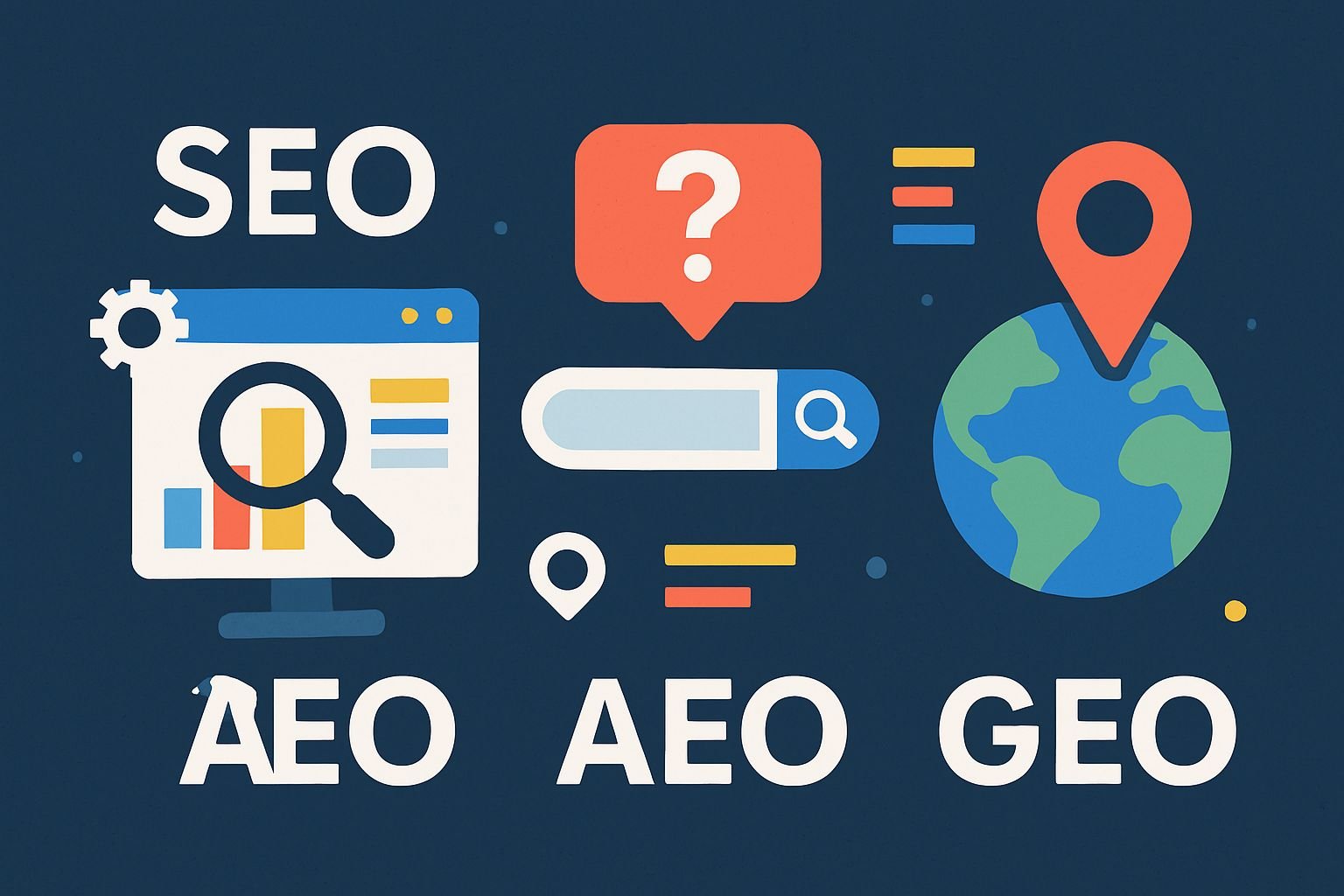
By 2026, blog structure must cater to three different systems — traditional search engines (SEO), answer engines (AEO), and generative AI tools (GEO) — each of which interprets your content in a unique way.
Headings are more important than you may realize — H2s and H3s now serve as points for AI systems to extract answers, not just visual breaks for the human eye.
Depth of content is more important than length of content — a well-structured 1,200-word post complete with direct answers, FAQ blocks, and schema markup will outperform a 3,000-word post that lacks a clear structure.
Topical clusters are the new measure of authority, not isolated keywords — internal linking patterns indicate to both Google and AI systems that your site is a subject matter expert.
There is one structural mistake that is killing visibility faster than any other in 2026 — and most marketers are still making it without even knowing.
Search has quietly become a three-part game, and most blogs are only playing one part.
Are you still structuring your blog posts like it’s 2021? If you are, you’re missing out on a lot of visibility. Google is still relevant, but now you have to consider other systems like ChatGPT, Perplexity, Google’s AI Overviews, and any other system that pulls answers directly from your content without sending users to your website. The marketers who understand how to structure content for SEO, AEO, and GEO are the ones who are showing up everywhere.
Three Engines Now Drive Blog Structure
The former model was straightforward: compose for humans, optimize for Google, and enjoy the traffic. That model is still partially effective. However, the search landscape now encompasses AI-generated responses, voice responses, featured snippets, and generative summaries that extract from your content without a click ever occurring. Your blog post must be structured in such a way that all three engines can simultaneously extract value from it.
This isn’t about crafting three different iterations of the same blog post. It’s about creating a single post that is structured in a way that caters to all three systems simultaneously. The best part? The structural guidelines for each are more alike than they are different. If you nail the structure, you’re automatically optimizing for all three.
SEO, AEO, and GEO Are Different Concepts
It’s common for these three terms to be used interchangeably, but this can lead to a lot of strategic confusion. They are related, but they each have their own unique outcomes and systems. For example, understanding the best SEO plugins for WordPress can significantly impact your SEO strategies.
SEO: The Bedrock, Yet Not the Be All and End All
Search Engine Optimization remains the cornerstone of content discoverability. It centers on positioning your pages in conventional search results via keyword targeting, backlinks, technical performance, and content quality signals. Google’s algorithm continues to generate significant traffic volumes, and overlooking SEO basics in pursuit of AI visibility is a misstep.
However, just having good SEO doesn’t mean your content will be seen. A page can be on the first page of search results and still not be the answer to an AI Overview that sits above all organic results. That’s where AEO and GEO come in.
AEO: Crafting the Perfect Response
Answer Engine Optimization is the art of creating content in such a way that search engines and AI systems highlight your content as the immediate response to a question. This is visible as featured snippets, People Also Ask boxes, voice search replies, and AI-generated answer overviews. AEO is less about ranking and more about selection.
There are very specific structural requirements for AEO. Answers must be upfront, direct, and formatted in a way that is easy for a machine to extract. Answers that are buried, language that is vague, and paragraphs that are a wall of text are all AEO killers.
GEO: Being Referenced by AI-Generated Responses
Generative Engine Optimization is the latest of the three. GEO is centered around making your content the type of source that AI tools such as ChatGPT, Perplexity, and Google’s AI Overviews draw from and cite when generating responses. It’s about authority signals, content clarity, and structured information that AI systems deem trustworthy enough to reference. If AEO is about being the solution, GEO is about being the source of the solution.
The Impact of Blog Structure on SEO, AEO, and GEO Strategies
Structure is more than just a visual aspect. How you organize headings, paragraphs, answers, and internal links provides clear indications to search algorithms and AI systems about the scope of your content, its authority, and its reliability as a source. While many marketers view structure as a matter of formatting, in 2026, it’s a factor in rankings and citations.
Imagine that your blog post is being read by three different types of readers at the same time — a human reader, a search engine crawler, and an AI content extraction system. Each one of these readers will interpret your content in a different way, but all three of them appreciate the same key structural elements: clarity, hierarchy, and specificity.
How Heading Hierarchy Communicates Authority to Search and AI Systems
Your H1 is your subject statement. Your H2s are your main subtopics. Your H3s are the supporting details within each subtopic. This is not just a design convention — it’s a semantic map that informs crawlers and AI systems how your content is structured and what connections there are between ideas.
When a human is asked a question about a topic, they will scan the page for headings to quickly find where the answer might be. If there’s a heading that says “What is AEO?” followed by a clear two-sentence answer, they’re far more likely to find that than the same information hidden in a paragraph under a non-descriptive heading like “Understanding Modern Search.”
Google’s guidelines on structured content support this. A well-defined heading hierarchy not only enhances crawlability but also helps to establish the depth of the topic. It also makes the content eligible for rich result features, which in turn, improve both AEO and GEO performance.
Content Depth vs. Content Length: Which Matters More?
When it comes to content, it’s not about the length, it’s about the depth. Depth trumps length. A 1,500-word post that provides direct answers to ten specific questions, with clear subheadings, succinct paragraphs, and supporting schema, will consistently outperform a 4,000-word post that takes a long time to get to the point, offering a lot of background context along the way. This is especially true for AI systems, which are not interested in lengthy introductions — they are designed to extract answers, not stories. For those looking to enhance their content strategy, exploring AI-powered chatbots can be a game-changer in delivering concise and relevant information.
When we talk about content depth, we mean providing enough detail and supporting information on a topic that it is seen as a reliable, comprehensive resource by both humans and AI systems. This could be achieved in 1,000 words or 3,000 words – it really depends on the topic. The goal is not to hit a certain word count, but to fully cover the topic at hand.
How Internal Linking Patterns Influence Topical Authority
Internal links are often an overlooked structural tool in content strategy. When done with purpose, they inform search engines that your site contains a network of related, authoritative content on a particular topic — which is exactly what topical authority needs. Random or sparse internal linking leaves authority signals disjointed and weakened.
Here are some tips on how to ensure your blog posts are linked properly:
- Link every blog post to a relevant pillar page or topic hub
- Link related supporting posts that cover subtopics of the same cluster
- Use descriptive anchor text that reflects the target page’s topic, not generic phrases like “click here”
- Ensure every new post receives at least one internal link from an existing page to avoid orphaned posts
- Audit internal links quarterly to ensure your cluster structure stays connected as you publish new content
Remember, the pattern of your internal links tells a story about what your site knows. A well-linked content cluster signals to Google — and increasingly to AI systems pulling citations — that your domain owns a subject area, not just a single post.
How to Structure Your Blog Post for SEO, AEO, and GEO in 2026
If you want to make sure your blog post is optimized for all three of these engines, you need to have a consistent post structure that works for both human readers and machine extraction. The structure I’m going to share with you is not just a theory. It’s based on how AI systems actually extract answers and how Google’s quality raters evaluate the depth of content.
Use this structure for all your future posts, and you’ll begin to create a content library that increases in visibility across traditional search, AI Overviews, and generative citation engines.
1. Start with a Straightforward Answer in the Introduction
Your post’s first paragraph should answer the main question posed by your title. Don’t hint at it. Don’t say it’s coming. Answer it. AI systems initially scan introductions when pulling content for featured snippets, and human readers decide whether to stay or leave within the first three seconds. A direct answer in one or two sentences at the beginning, followed by a more detailed explanation, works for both. This is sometimes referred to as the “inverted pyramid” structure — start with the conclusion, then build the supporting case underneath it.
2. Use H2s as Standalone Answer Blocks, Not Just Section Dividers
Every H2 in your post should be written as a question or a clear statement that could stand alone as a search query. Immediately beneath each H2, write one to three sentences that directly answer that heading before expanding into supporting detail. This creates what AI extraction systems love most: a clean question-answer pair with a clear semantic boundary. If your H2 is “How Does AEO Affect Blog Structure,” the first sentence under it should answer exactly that — not warm up to the answer over three paragraphs.
3. Incorporate Structured FAQ Blocks Throughout Posts, Not Just at the End
Many marketers simply place a FAQ section at the end of a post. This method overlooks the true potential. Including brief FAQ blocks within pertinent sections — exactly where a reader would logically have an additional question — establishes numerous answer extraction points throughout the post. Every integrated FAQ pair turns into a potential featured snippet, a People Also Ask box, or an AI-quoted response. More extraction points signify more surface area for visibility across all three engines.
4. Include Brief Summaries Under Each Major Heading
Under every H2 heading, add a concise summary that is two to three sentences long. This summary should encapsulate the main idea of the section. This strategy is beneficial for both human readers and AI systems. For human readers, it emphasizes the main point before they continue to the next section. For AI systems, it offers a ready-made summary that doesn’t require interpretation. If you’re using WordPress, consider exploring SEO plugins like Squirrly SEO or Yoast to enhance your content strategy.
Consider these summary paragraphs as the “in a nutshell” for each section — but composed with the same excellence and precision as the comprehensive content, not as a slapdash summary. The objective is to provide AI instruments a neat, credible sentence they can incorporate directly into a produced response and credit to your content.
5. Link Each Article to a Subject Cluster, Not Just a Keyword
Every article you write should be part of a carefully planned subject cluster — a collection of related articles that together provide a comprehensive coverage of a subject area. Your cluster should have one main article that covers the general subject and several supporting articles that delve into specific aspects of the subject. Each supporting article should link back to the main article, and the main article should link to each supporting article. For more insights on structuring content, check out this new playbook for visibility in 2026.
Cluster architecture provides a benefit that isolated keyword targeting cannot: it shows Google and AI systems that your website has extensive, interconnected knowledge on a topic. When an AI tool is determining which source to cite for a generative response, domain authority on a specific topic — indicated through cluster architecture — is a crucial trust factor. A post that is part of a robust cluster is much more likely to be cited than an orphaned post targeting the same keyword.
Why Structured Data is Still Important and What You Should Focus On
Schema markup is the language you use to directly tell machines what your content is about. Even though Google has minimized the visual importance of some schema types in search results, structured data is still a crucial way for AI systems to understand and categorize your content. The two most important schema types for blog content in 2026 are Article schema and FAQ schema.
Using Article Schema for Blog Posts
Article schema is a tool that helps search engines and AI systems understand what your content is about, who wrote it, when it was published, and when it was last updated. For GEO, the author and dateModified fields are key — AI systems prefer content that is linked to a credible author and that has been updated recently. Every blog post should at least have Article schema with these properties filled in: headline, author, datePublished, dateModified, and publisher. These aren’t just nice-to-haves — they’re trust signals that can influence whether your content gets cited.
How FAQ Schema Helps AEO
Type of Schema Main Advantage Best Use AEO Effect Article Schema Defines the type of content and author All blog articles Medium — enhances trust signals for AI citation FAQ Schema Highlights question-answer pairs for extraction Articles with FAQ sections High — directly contributes to People Also Ask and AI answer extraction HowTo Schema Organizes step-by-step instructions Instructional and process articles Medium-High — eligible for rich results and voice responses Speakable Schema Pinpoints content optimized for voice Articles targeting voice search queries High — directly contributes to Google Assistant and voice-based AI
The FAQ schema operates by clearly marking question-and-answer pairs within your HTML, making it incredibly simple for search engines and AI systems to identify and extract those pairs as direct answers. Even though Google has reduced the display of FAQ rich results in standard search pages, the underlying schema still impacts how AI Overviews and generative tools interpret and utilize your content.
The crucial point is that the FAQ schema you use must correspond to content that is actually present on the page — in a way that’s visible and word-for-word. Concealing schema-marked content from users goes against Google’s guidelines and will have negative consequences. Every question-answer pair you mark up in schema should be understandable to a human visitor on the page without any extra interaction.
By merging the Article schema with the FAQ schema in the same article, you provide the AI with a layered machine-readable context. This informs the AI about the nature of the document, its author, and the parts of it that directly answer specific questions. This combination is the closest you can get to a guaranteed extraction signal as structured data in 2026.
Typical Blog Structure Errors That Are Ruining Your Visibility in 2026
The majority of blog posts are not unsuccessful due to poor content, but rather due to a structure that prevents search engines and AI systems from efficiently deriving value from them. The content may be truly insightful, thoroughly researched, and well-written, but it may still be overlooked in AI Overviews, featured snippets, and generative citations due to a structure that hinders extraction. For those looking to improve their blog’s performance, exploring AI-powered solutions might be beneficial.
The errors listed below aren’t just rare occurrences. They’re common trends that are prevalent in most business blogs today. Correcting them doesn’t mean you have to completely overhaul your content, but rather restructure how it’s organized and indicated with AI-powered tools.
Hiding the Answer Too Far Down in the Article
The most frequent structural error in content marketing is this one, and it silently kills AEO performance. When a reader — or an AI system — has to sift through three paragraphs of background information before getting to the actual answer to the question your headline posed, you’re already behind. AI extraction systems don’t reward patience. They extract from the first clear, direct answer they come across. If your answer is hidden in the sixth paragraph, your competitor who put their answer in the first paragraph gets the citation instead.
Headings as Labels vs. Answers
When you use a heading like “Content Strategy Considerations,” you’re not giving an AI system any useful information. But if you use a heading like “How Does Content Structure Affect AI Citation?,” you’re telling the AI system exactly what question the following section answers. This might seem like a small difference, but in reality, it could be the difference between your content being extracted and your content being completely ignored.
Headings serve as signposts for both search engine crawlers and AI tools that generate content. When these tools are scanning a document to see if it has an answer to a particular question, they first compare the text in the headings to the pattern of the question. Headings that are vague or are just labels will fail this comparison every time, no matter how good the content under them might be.
There is a simple solution: change every H2 and H3 to a direct question or a clear declarative statement that reflects how your target reader would phrase a search query. For example, “Types of Schema Markup” becomes “Which Schema Markup Types Are Most Important for Blog SEO in 2026?” This small change takes about thirty seconds and can significantly increase your chances of being extracted across all three engines. For more insights on SEO strategies, you can explore the new playbook for visibility in 2026.
Leaning Too Much on Human Readability and Forgetting AI Readability
Human readability and AI readability are different beasts, and focusing on one at the expense of the other is a structural oversight that is tripping up an increasing number of marketers. A beautifully crafted, story-driven blog post with flowing prose and carefully constructed tension can be a genuinely engaging read for humans and a nearly impossible extraction target for AI systems. Generative tools aren’t reading for pleasure — they’re scanning for answer density, structural clarity, and semantic precision.
However, this doesn’t mean your content should feel robotic or clinical. You need to incorporate machine-readable signals into your content while keeping it engaging for humans. This can be done using direct answers, clear headings, concise summary sentences, and structured schema. This way, you won’t have to compromise the quality of your content. The aim is to create a post that not only humans want to read, but also one that an AI can confidently extract answers from.
There are some clear signs that your content isn’t up to scratch when it comes to AI readability. These include: answers that only make sense when read in the context of the rest of the article, a lack of clear question-answer pairs that you’d typically find in an FAQ, headings that don’t accurately reflect the content beneath them, and a total lack of structured data markup. If your posts are guilty of all four of these things, then it’s highly likely that your GEO and AEO performance is practically non-existent, no matter how well the post ranks in a traditional search.
- Include at least one direct answer sentence in the first 100 words of every post
- Replace each vague heading with a question or a declarative statement that reflects a real search query
- Add a minimum of three embedded FAQ pairs within the body of each post, not just at the end
- Include a summary paragraph of two to three sentences at the end of every major H2 section
- Apply Article schema and FAQ schema on every post, with all key fields filled
- Check every post for orphaned status — if there are no internal links pointing to it, correct that immediately
The Structure of Your Blog Determines Whether AI Chooses You or Your Competitor
In 2026, the visibility gap between well-structured and poorly structured content is greater than ever before. It’s not just about whether you rank — it’s about whether AI systems trust your content enough to extract from it, cite it, and surface it in generated responses that millions of users never click away from. Structure is what sends that trust signal. Clever writing alone is not enough. For instance, optimizing your website’s performance can significantly enhance its structure and reliability.
Every blog post you publish is a chance to claim a piece of the pie across three different engines at the same time. The marketers who are succeeding right now are not churning out more content — they are producing more intelligently-structured content that accomplishes more per post. Streamline your heading hierarchy, prioritize your answers, develop your clusters, and outline your schema. Those four steps, implemented regularly, are what distinguish brands that are omnipresent from brands that are gradually vanishing from the locations where their audience is actually searching.
Commonly Asked Questions
These are the questions most often asked by marketers when they are reconsidering their blog structure for contemporary search. Every answer is intended to be immediately applicable, not theoretical.
How does AEO differ from GEO in blog optimization?
AEO (Answer Engine Optimization) is all about having your content chosen as the direct response to a user’s question. This means appearing in featured snippets, “People Also Ask” boxes, voice search results, and AI-generated answer summaries. The objective is to become the answer that is surfaced, regardless of whether a click occurs or not. For those interested in enhancing their blog’s performance, exploring AI-powered chatbots can be a valuable addition.
GEO (Generative Engine Optimization) takes it a step further. It emphasizes making your content a reliable source that AI tools such as ChatGPT, Perplexity, and Google’s AI Overviews regularly reference when creating more extensive responses. AEO is about being selected as the answer. GEO is about being recognized as the authority behind it. Both require similar structural foundations — direct answers, clear headings, schema markup — but GEO puts more importance on domain authority, authorship signals, and content freshness.
Is the conventional SEO blog structure still effective in 2026?
The conventional SEO structure — keyword-focused title, introduction, H2-segmented sections, conclusion — remains a solid foundation. It will still get your content indexed and qualified for organic rankings. However, what it won’t do on its own is secure you a spot in AI Overviews, featured snippets, or generative citations. Achieving these results necessitates the additional structural layers demanded by AEO and GEO: answers at the beginning, headings in the form of questions, embedded FAQ blocks, schema markup, and topical cluster architecture.
Consider traditional SEO structure as the foundation, not the limit. It’s essential but not enough. Each blog post you put out there should satisfy traditional SEO standards and add AEO and GEO structural cues on top. The two methods are complementary, not conflicting.
What is the ideal blog post length for SEO, AEO, and GEO?
There isn’t a one-size-fits-all word count that will ensure success on all three platforms. The key is to provide a comprehensive answer to the query — does your blog post fully answer the question it’s addressing, and does it provide enough detailed support to be seen as authoritative? A well-structured 1,200-word blog post with direct answers and schema markup will consistently perform better than a 3,500-word blog post that hides its answers in unnecessary narrative.
Here’s a good rule of thumb: informational blog posts that target competitive queries usually do well when they’re in the 1,200 to 2,000 word range and are structured correctly. Pillar pages that cover broad topic areas often need to be 2,500 to 4,000 words long to establish topical completeness. Supporting cluster posts can be as short as 800 words if they answer a specific subtopic precisely and link back into the cluster properly. Let the complexity of the query determine the length, not some arbitrary word count target.
Is FAQ schema still useful for AEO, even after Google reduced its visibility?
Yes — and this is one of the most misunderstood aspects in current discussions about content strategy. Just because Google reduced the visual display of FAQ rich results on standard search pages, doesn’t mean that FAQ schema has lost its value. It simply means that the visual output has changed, not the underlying signal. FAQ schema still provides question-answer pairs directly to AI systems and continues to affect how generative tools extract and attribute answers from your content. If anything, FAQ schema is now more important for AI citation purposes than it ever was for traditional rich result display. So, keep using it, keep marking it up accurately, and make sure that every schema-marked Q&A pair is visible on the page.
How can I tell if AI search engines are citing my blog?
Direct citation tracking for AI tools is still a developing field, but there are several practical methods available at the moment. Perplexity.ai clearly displays its sources in its responses — you can search your target queries directly in Perplexity and see if your domain appears as a cited source. Google’s AI Overviews in Search also show source links under generated summaries, and Google Search Console is starting to show impression data related to AI Overview appearances for some users.
Aside from direct assessments, keeping an eye on your branded search volume over time can be a useful indirect indicator. When AI tools start regularly referencing your content, branded query volume tends to go up as users search directly for your domain after seeing it in AI-generated responses. A rising trend in branded impressions without a corresponding increase in new content often indicates growing AI citation activity.