Cohort based courses, eLearning courses


The landscape of digital learning is constantly evolving, offering a diverse array of options for individuals seeking to acquire new skills, advance their careers, or pursue personal interests. Among the most prominent and impactful approaches are eLearning courses and Cohort-Based Courses (CBCs). While both leverage technology to deliver educational content, they offer distinct learning experiences, catering to different needs and learning preferences. Understanding these differences is crucial for learners to make informed decisions about their educational journey.
eLearning courses, in their most common iteration, represent the digital evolution of traditional correspondence courses. Think of them as self-paced journeys through a vast library of knowledge, accessible from virtually anywhere with an internet connection. The core appeal of eLearning lies in its inherent flexibility and broad accessibility.
Asynchronous Learning: The Self-Paced Voyage
The cornerstone of many eLearning courses is asynchronous learning. This means that you, the learner, dictate the pace at which you consume the material. There are no fixed class times or real-time lectures you’re obligated to attend. This is akin to having a personalized tutor who is available whenever you are, allowing you to revisit complex topics as many times as needed and skip over concepts you already grasp. This autonomy is particularly beneficial for individuals balancing work, family, or other commitments.
Content Delivery Formats: A Multimodal Approach
eLearning courses employ a rich tapestry of content delivery methods. You’ll find video lectures, interactive modules, downloadable readings, quizzes, assignments, and sometimes even simulations. This multi-modal approach caters to different learning styles, allowing visual, auditory, and kinesthetic learners to engage with the material in ways that resonate best with them. Imagine a well-stocked toolbox, where each tool is designed for a specific task, enabling you to build your understanding piece by piece.
Scalability and Reach: Impacting the Global Learner
One of the significant advantages of eLearning is its scalability. A single well-designed eLearning course can theoretically reach millions of learners worldwide, breaking down geographical barriers to education. This democratizing effect allows individuals in remote areas or those with limited mobility to access high-quality educational content previously unavailable to them. The internet acts as a universal highway, transporting knowledge to every corner of the globe.
Cost-Effectiveness: Value for the Investment
Often, eLearning courses present a more cost-effective alternative to traditional in-person education. The reduced overhead associated with physical infrastructure and the ability to serve a larger student base can translate into lower tuition fees. This makes education more attainable for a wider segment of the population, representing a significant return on investment for aspiring learners.
Cohort-based courses have gained significant popularity in the realm of eLearning, offering a structured and interactive learning experience that fosters community engagement among participants. For those interested in exploring innovative educational tools that enhance the learning process, a related article discusses the benefits of no-code app builders, which can be instrumental in creating customized learning platforms. You can read more about this topic in the article titled “Hostinger Horizons: Best No-Code App Builder” available at Hostinger Horizons: Best No-Code App Builder.
The Power of Community: Understanding Cohort-Based Courses
Cohort-Based Courses (CBCs) introduce a dynamic element often missing in standard eLearning: a focused, time-bound learning community. Instead of embarking on a solitary quest, you join a group of fellow learners, all starting and progressing through the curriculum together. This shared journey fosters a sense of camaraderie and collective learning, transforming the educational experience.
Synchronous and Asynchronous Blend: Navigating the Current
While some CBCs lean heavily on synchronous (real-time) interactions, most effectively blend synchronous and asynchronous elements. Live sessions, such as Q&A calls, workshops, or group discussions, provide immediate interaction and can clarify complex points in real-time. These are often complemented by asynchronous materials that learners can engage with at their own pace between live sessions. This combination is like having a guided expedition where the guide is available for live consultations, but you also have detailed maps and survival guides to study independently.
Peer-to-Peer Learning: The Collective Intelligence
A defining characteristic of CBCs is the emphasis on peer-to-peer learning. Within the cohort, you have direct opportunities to learn from your peers through discussions, group projects, and shared problem-solving. This fosters a rich ecosystem of diverse perspectives and experiences, allowing you to see concepts from multiple angles. It’s like being part of a think tank, where the combined intellect of the group can unlock solutions that an individual might struggle to find alone.
Structured Learning Paths: A Guided Ascent
CBCs typically provide a more structured and guided learning path compared to the open-ended nature of some eLearning. The fixed start and end dates, along with a defined curriculum, create a sense of urgency and accountability. This structure can be highly motivating for learners who thrive on deadlines and a clear roadmap towards their objectives. Imagine climbing a mountain with a seasoned guide who sets the pace, points out the best routes, and ensures you don’t stray off the path.
Accountability and Motivation: The Shared Momentum
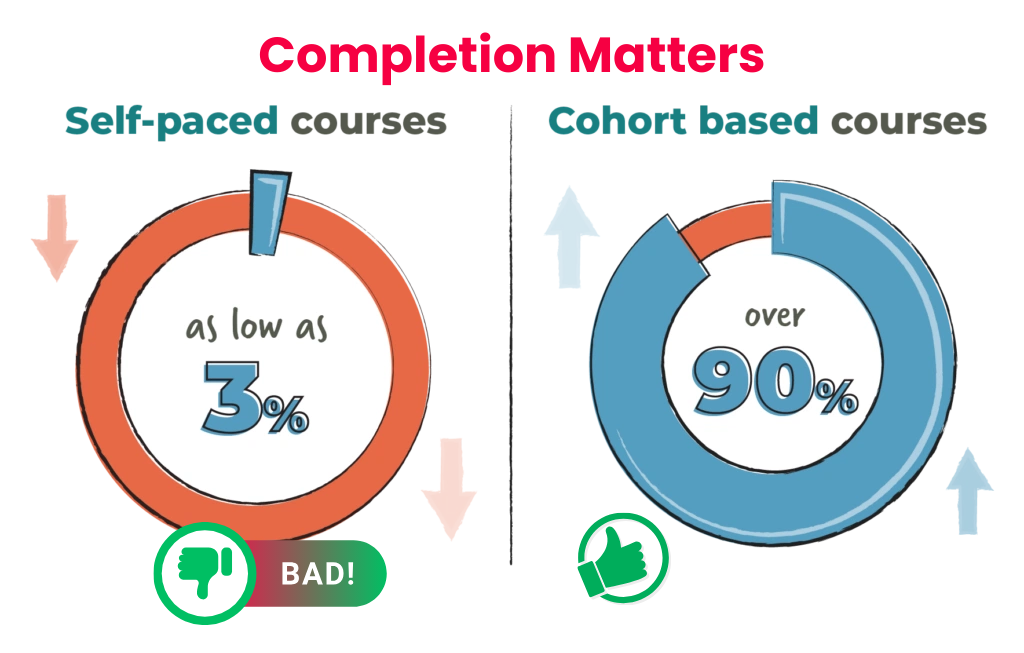
The presence of a cohort acts as a powerful motivator. Knowing that others are on the same journey, facing similar challenges, and working towards the same goals instills a sense of accountability. The desire to keep up with the group, contribute to discussions, and complete assignments can significantly boost completion rates. This shared momentum propels the group forward, creating a supportive environment where everyone benefits from collective drive.
Key Differentiators: eLearning vs. Cohort-Based Courses
To solidify your understanding, let’s examine the core differences between these two learning modalities. These distinctions will help you pinpoint which approach best aligns with your learning style, goals, and current circumstances.
Pace and Structure: The Unfolding Narrative vs. The Timed Event
As discussed, eLearning thrives on asynchronous, self-paced learning, offering unparalleled flexibility. CBCs, conversely, operate on a fixed schedule with defined start and end dates, providing a more structured and often accelerated learning experience. The former is like a sprawling novel you can read at your leisure, while the latter is a gripping screenplay that unfolds over a specific timeframe.
Community and Interaction: The Solitary Scholar vs. The Collaborative Explorer
The isolated learner is the hallmark of traditional eLearning. While some offer discussion forums, the depth of interaction is often limited. CBCs, however, place a premium on community. They are designed to foster active participation, peer-to-peer learning, and a strong sense of connection among participants. This is the difference between exploring a historical site alone with a guidebook and joining a guided tour with fellow enthusiasts.
Accountability and Completion: The Self-Driven Journey vs. The Group Endeavor
Completion rates can vary significantly between eLearning and CBCs. The self-directed nature of eLearning places the onus of completion entirely on the individual. CBCs, with their built-in accountability mechanisms through peer interaction and fixed deadlines, often achieve higher completion rates. The shared responsibility within a cohort acts as a powerful catalyst for seeing the learning process through to its conclusion.
Instructor Role: The Content Curator vs. The Facilitator and Guide
In many eLearning courses, the instructor’s primary role is to create and curate the content. While they may be available for support, direct interaction can be limited. In CBCs, the instructor often takes on a more active role as a facilitator, guide, and even mentor. They lead discussions, provide feedback, and foster a collaborative learning environment, becoming an integral part of the cohort’s journey.
Choosing Your Path: Matching Modality to Your Needs

The decision between an eLearning course and a Cohort-Based Course is not about one being inherently superior to the other, but rather about identifying which best serves your individual learning objectives and preferences.
For the Busy Professional: The Flexible Solution
If your schedule is perpetually packed, and you require the ability to learn on your own terms, traditional eLearning courses are likely your most practical option. The ability to pause, rewind, and fit learning modules into short pockets of free time is invaluable. This is ideal for those who want to upskill without disrupting their existing professional and personal commitments.
For the Social Learner: The Engaging Community
If you thrive on interaction, find motivation in group settings, and believe that learning is amplified through discussion and collaboration, CBCs will likely be a more fulfilling experience. The sense of belonging and the opportunity to learn from others can transform a passive learning experience into an active, engaging one. This is for individuals who enjoy brainstorming, debating ideas, and building relationships with like-minded people.
For the Goal-Oriented Learner: The Accelerated Journey
| Metric | Cohort-Based Courses | eLearning Courses |
|---|---|---|
| Average Completion Rate | 70-85% | 10-30% |
| Average Course Duration | 4-8 weeks | Self-paced (varies) |
| Interaction Level | High (peer & instructor interaction) | Low to Medium (mostly self-study) |
| Typical Class Size | 20-100 students | Unlimited |
| Cost Range | Moderate to High | Low to Moderate |
| Flexibility | Fixed schedule | Completely self-paced |
| Assessment Type | Peer reviews, live projects, quizzes | Automated quizzes, assignments |
| Certification | Often included with cohort completion | Varies by platform |
If you have a clear, time-sensitive objective and require a structured, disciplined approach to achieve it, a CBC can be highly effective. The defined timeline and the pressure of a cohort can accelerate your progress and ensure you stay focused. This is for those who are ready to commit to an intensive learning period to achieve a specific outcome.
For the Independent Explorer: The Depth of Self-Paced Study
If you enjoy deep dives into subjects at your own pace, are highly self-disciplined, and prefer to explore topics without external time constraints, eLearning offers the freedom to do so. You can spend as much time as needed on each concept, ensuring a thorough understanding. This suits learners who are comfortable with autonomy and have a strong intrinsic motivation.
Cohort-based courses have gained significant popularity in recent years, especially as more learners seek interactive and community-driven learning experiences. These courses often foster collaboration among participants, enhancing the overall educational journey.
The Future of Learning: Convergence and Integration
The distinction between eLearning and CBCs may become increasingly blurred as educational platforms evolve and innovate. We are likely to see a greater integration of features from both modalities. Imagine eLearning courses that incorporate more robust community-building tools and live interaction opportunities, and CBCs that leverage sophisticated AI to personalize asynchronous content delivery.
Hybrid Models: The Best of Both Worlds
The future may hold a rise in hybrid learning models that combine the flexibility of asynchronous eLearning with the engagement and accountability of cohort-based learning. This could involve a core eLearning curriculum supplemented by periodic live sessions, group projects, or mentorship opportunities within smaller cohorts. This approach aims to offer a balanced learning experience, catering to a wider range of learner needs.
Technology’s Role: Personalization and Engagement
Advancements in learning technologies, such as artificial intelligence (AI) and virtual reality (VR), will undoubtedly play a significant role in shaping both eLearning and CBCs. AI can personalize learning paths, provide intelligent tutoring, and offer data-driven insights into learner progress. VR can create immersive learning environments, making abstract concepts more tangible and engaging. The digital classroom of the future will likely be a dynamic and adaptive space.
The Learner as Architect: Designing Your Ideal Education
Ultimately, the most effective learning experience is one that you design for yourself. By understanding the strengths and characteristics of both eLearning and Cohort-Based Courses, you can become the architect of your own educational journey. Whether you seek the flexibility of a self-paced voyage or the motivation of a shared expedition, there is a digital learning modality ready to guide you. The key lies in thoughtful consideration of your personal learning style, your current life circumstances, and your ultimate educational goals.
FAQs
What are cohort-based courses?
Cohort-based courses are structured learning programs where a group of students progress through the material together at the same pace. These courses often include scheduled sessions, group discussions, and collaborative projects, fostering a community learning environment.
How do cohort-based courses differ from traditional eLearning courses?
Unlike traditional eLearning courses that allow self-paced study, cohort-based courses follow a fixed schedule with set start and end dates. This format encourages interaction among participants and provides real-time feedback from instructors, enhancing engagement and accountability.
What are the benefits of taking cohort-based courses?
Benefits include increased motivation through peer support, opportunities for networking, structured learning timelines, and direct access to instructors. These factors can lead to higher completion rates and a deeper understanding of the course material.
Can cohort-based courses be completed entirely online?
Yes, many cohort-based courses are offered fully online, utilizing video lectures, live webinars, discussion forums, and collaborative tools to facilitate interaction and learning without the need for physical attendance.
Who typically offers cohort-based eLearning courses?
Cohort-based courses are commonly offered by universities, professional training organizations, and online education platforms. They cater to learners seeking structured programs in various fields, including technology, business, and personal development.